
Lee County Court Records After Arrest
In Lee County, court records after a jail arrest usually start with an arrest by a local or state law-enforcement agency, booking through the regional detention channel, and an early bond or first-appearance step. After that, criminal charges move through the court system. General Sessions is the criminal court for felony-level matters, and the Lee County Clerk of Court page states that General Sessions houses criminal warrants, bond paperwork, motions, and sentencing sheets.
The jail side and the court side answer different questions. The roster may show whether a person is in custody, what hold reasons appear, and whether bond text has been entered. The court record shows what was filed in court, whether the charge remains pending, and whether there is a disposition. For custody and booking details, use Lee County jail inmate records. For booking photos, use Lee County jail mugshots. Court records after an arrest should be read through the Lee County Public Index and clerk records.
Lee County Public Index Search
The South Carolina Judicial Branch provides the statewide case-records gateway and a Lee County Public Index route. The Judicial Branch warns that cookies and JavaScript must be enabled and that some browsers may require pop-up exceptions to open case detail. Lee County is in Judicial Circuit 3, and the courthouse page lists Lee County Courthouse as the local court hub for case records, rosters, public defender, and solicitor links.
The Lee County Public Index search form is the direct portal for many Lee County court records after a jail arrest.
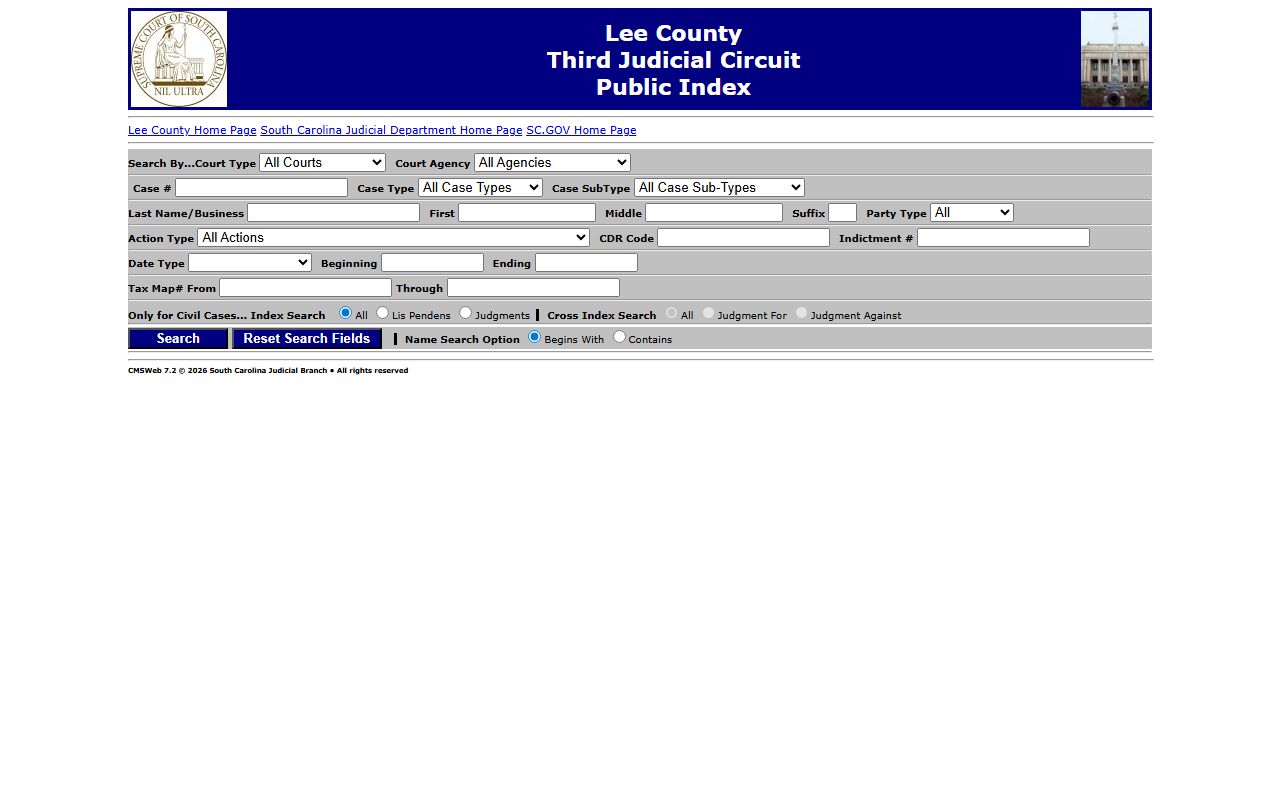
The Public Index is where a booking allegation can be matched against filed charges, status entries, hearing dates, and dispositions when those records are public.
| Field Label | Type | Required | Options / Format Notes |
|---|---|---|---|
| Court Agency / Court Type | Dropdown | Varies by page | Circuit Court, Magistrate, and other available court types may appear. |
| Case Number | Text | Optional | Best when the exact court case number is known. |
| Last Name / Business Name | Text | Optional | Use the defendant or party last name. |
| First Name | Text | Optional | Narrows a broad surname search. |
| Middle Name | Text | Optional | Helpful when multiple people share a similar name. |
| Date Filed / Case Date Range | Date | Optional | Use date ranges for older or common-name searches. |
| Action Type / Case Type | Dropdown | Optional | Criminal, Common Pleas, and Magistrate filters vary by court page. |
From Arrest to Court Filing
The arrest-to-court path in Lee County has several steps. A law-enforcement officer makes the arrest or executes a warrant. The person is booked if not released immediately. Bond or first appearance is handled by magistrate or bond court. Then formal charges move into the court system, where the Third Circuit Solicitor pursues criminal prosecution for Lee County. The Public Index may show the case filing, charges, court dates, and disposition once a court record exists.
- Check the jail roster first if the person may still be in custody.
- Search the Public Index by name or case number for filed court records.
- Open the case detail and compare the court charge list to the booking text.
- Review charge status, court dates, bond orders, and disposition entries.
- For certified copies or older files, contact the clerk rather than relying on a screen print.
Booking language and court language can differ. A warrant or hold reason may use law-enforcement wording. The solicitor may amend, reduce, dismiss, or pursue different charges after reviewing the case file.
Lee County Charging Documents
Charging documents are the papers that move an accusation from arrest into court. South Carolina local practice can involve complaint-level filings in magistrate matters, solicitor filings in General Sessions, and indictment for serious charges. The exact document depends on the court, charge type, and stage of the case. A court record after a jail arrest may show one charge at booking and a more formal or revised charge later in court.
| Document | Who Uses It | What It Means | Where It Appears |
|---|---|---|---|
| Complaint | Officer, magistrate process, or prosecutor depending on matter | Starts or supports a lower-level criminal accusation after arrest. | Magistrate or related court record. |
| Information | Prosecutor | Formal prosecutor-filed charge when allowed by procedure. | General Sessions or court file. |
| Indictment | Grand jury process | Formal accusation used for serious felony prosecution. | General Sessions record and clerk file. |
Lee County Charge Status
Court records after a jail arrest are useful because a charge can change. The Public Index can show whether a case is pending, disposed, dismissed, or otherwise resolved. A status line should be read with the charge text, date, court level, and disposition. If a case moved from magistrate court to General Sessions, more than one record may need to be checked.
| Status | Plain Meaning | Search Tip |
|---|---|---|
| Pending | The court case is still active and no final outcome is shown. | Check future court dates and bond conditions. |
| Amended / Reduced | The filed charge changed from the original wording or level. | Compare the newest court charge to the booking charge. |
| Dismissed | The charge was ended by court action or prosecution decision. | Look for related charges that may still remain. |
| Nolle Prosequi | The prosecutor did not pursue that charge. | Use the disposition date when checking eligibility for later relief. |
| Convicted / Guilty Plea | The charge ended in a conviction by plea or finding. | Review sentence and SCDC transfer information if prison applies. |
Bond After Lee County Arrest
Bond is set by a court, not by the roster. The Sumter detention FAQ says bond hearings are held Monday through Friday at 8 a.m. and 2 p.m., with weekend and holiday hearings as needed and no afternoon sessions on those days. Hearing times may change at the magistrate judge's discretion, so the jail phone line should be used for live confirmation. The roster can still be useful because sample records exposed bond type, amount, and judge text inside hold reasons.
| Bond Context | How It Affects Court Records |
|---|---|
| Surety bond | A bonding agency helps secure release after the needed court paperwork is complete. |
| Cash or percentage option | Some roster language may show a ten-percent option when a judge sets it. |
| Personal recognizance | Release may be based on a promise to appear, though the local FAQ does not detail it. |
| Denied or no bond | The person remains held unless a court changes the order or another authority applies. |
| Hold or detainer | Another agency, warrant, probation issue, USMS, ICE, or SCDC matter can block release. |
Warrants Before Court Records
No official Lee County active criminal warrant list was located in the research sources. The Sumter-Lee portal exposes a warrants route in the application, and the Sumter sheriff has a Civil Process/Warrants Division page, but that page describes civil writs and courtroom-security work rather than a complete searchable criminal warrant database. The jail roster can become a warrant channel after arrest because hold reasons may list warrant number, charge text, issuing jurisdiction, bond type, amount, and judge.
Bench warrants, arrest warrants, and out-of-county holds should be checked through the court or the agency that issued them. The Sumter sheriff warrants/civil process number is 803-436-2020, the Sumter front desk is 803-436-2000, and the Lee County Sheriff's Office is 803-484-5353. Emergency matters still go to 911. For paperwork tied to a filed case, use court records rather than a general web search.
Charges vs Convictions
A charge is an accusation. A conviction is a court outcome. That distinction is central to Lee County court records after a jail arrest because a roster entry, warrant entry, or filed charge does not prove guilt. The final court disposition decides whether a charge ended by plea, trial, dismissal, nolle prosequi, sentence, or another result.
| Issue | Charge | Conviction |
|---|---|---|
| Stage | Accusation after arrest or filing | Final finding or plea outcome |
| What proves it | Warrant, complaint, information, indictment, or case filing | Court judgment, plea, verdict, or sentencing entry |
| Can it change | Yes, charges may be amended, reduced, added, or dismissed | Changes usually require court action, appeal, relief, or expungement process |
| Search source | Roster and Public Index | Public Index, clerk record, SCDC if prison sentence follows |
Sealed vs Expunged Records
South Carolina law includes expungement and destruction procedures for certain arrest and criminal records. S.C. Code 17-1-40 covers qualifying destruction or expungement handling for certain non-conviction outcomes, and Title 17 Chapter 22 contains expungement provisions for certain summary court and criminal records. Court records after a jail arrest may still be visible unless a court order or qualifying process changes public access.
| Question | Sealed or Restricted | Expunged |
|---|---|---|
| Public visibility | Access is limited or hidden from ordinary public view. | Qualifying records are removed or destroyed as the law permits. |
| How it happens | Court rule, statute, juvenile status, privacy rule, or order. | Formal expungement process under South Carolina law. |
| Typical trigger | Juvenile matter, protected information, or sensitive court order. | Eligible dismissal, nolle prosequi, or other qualifying disposition. |
| Where to ask | Clerk of Court or the court handling the file. | Clerk, solicitor, or authorized expungement process. |
Lee County Court Contacts
Official court contact points matter when the Public Index is incomplete, old records need certified copies, or a bond document must be verified. The South Carolina Judicial Branch Lee County courthouse page lists Lee County Courthouse at 123 S. Main Street, Bishopville, SC 29010, Judicial Circuit 3, and links to case records and court resources. The Lee County Clerk of Court / Family Court page identifies the office tied to General Sessions materials such as criminal warrants, bond paperwork, motions, and sentencing sheets.
Lee County Courthouse
123 S. Main Street
Bishopville, SC 29010
Judicial Circuit 3
Third Circuit Solicitor, Lee County contact
Phone: 803-484-5341 ext. 381
Fax: 803-484-4061
Third Circuit Solicitor
South Carolina uses circuit solicitors rather than district attorneys. The state prosecution coordination page identifies Ernest A. Finney, III as the Third Circuit Solicitor.
The Third Circuit Solicitor page covers General Sessions, juvenile prosecution, victim services, Pretrial Intervention, and juvenile arbitration for the circuit that includes Lee County. Victim notification can also be handled through South Carolina VINELink when a custody or case notification is needed.